
Freshwater Water Read
Bayou Lacombe and Bayou Cane: Reading a Rising Northshore Drain Without Losing the Day
A rising Northshore drain can still fish, but only if you stop treating it like the whole bayou changed the same way. Bayou Lacombe and Bayou Cane usually become fishable again when you find the first place that softens the push enough for fish to hold.
First move
Start with the decision
- Start here: Start on the first bend, wood line, shaded bank, or bottom seam where current softens but still carries food.
- If not working: Move to the next softened lane with better color, more stable depth, or cover that actually lets fish hold.
- Avoid: Do not stay on straight, pushy, stained stretches that have no softened current, no holding cover, and no readable bottom seam.
The read
A rising Northshore drain can still fish, but only if you stop treating it like the whole bayou changed the same way. It did not. Bayou Lacombe and Bayou Cane usually become fishable again when you find the first place that softens the push enough for fish to hold.
The mistake
Most people fish the whole bayou the same once it rises. They run straight stretches, cover water, and hope it cleans up. That is where the day gets lost. Rising water spreads the problem, but it also creates small places that still work.
What is actually happening
Rising water adds push, stain, and fresh influence. Fish do not always leave. They shift to the first place that gives them reduced current, stable depth, and usable cover.
- Reduced current.
- Stable depth.
- Usable cover.
The pattern
The pattern is simple: find the first softened lane, not the prettiest water. That is usually a bend, a wood line, a shaded bank, a bottom seam, or a side lane off the main push.
- A bend.
- A wood line.
- A shaded bank.
- A bottom seam.
- A side lane off the main push.
What this looks like on the water
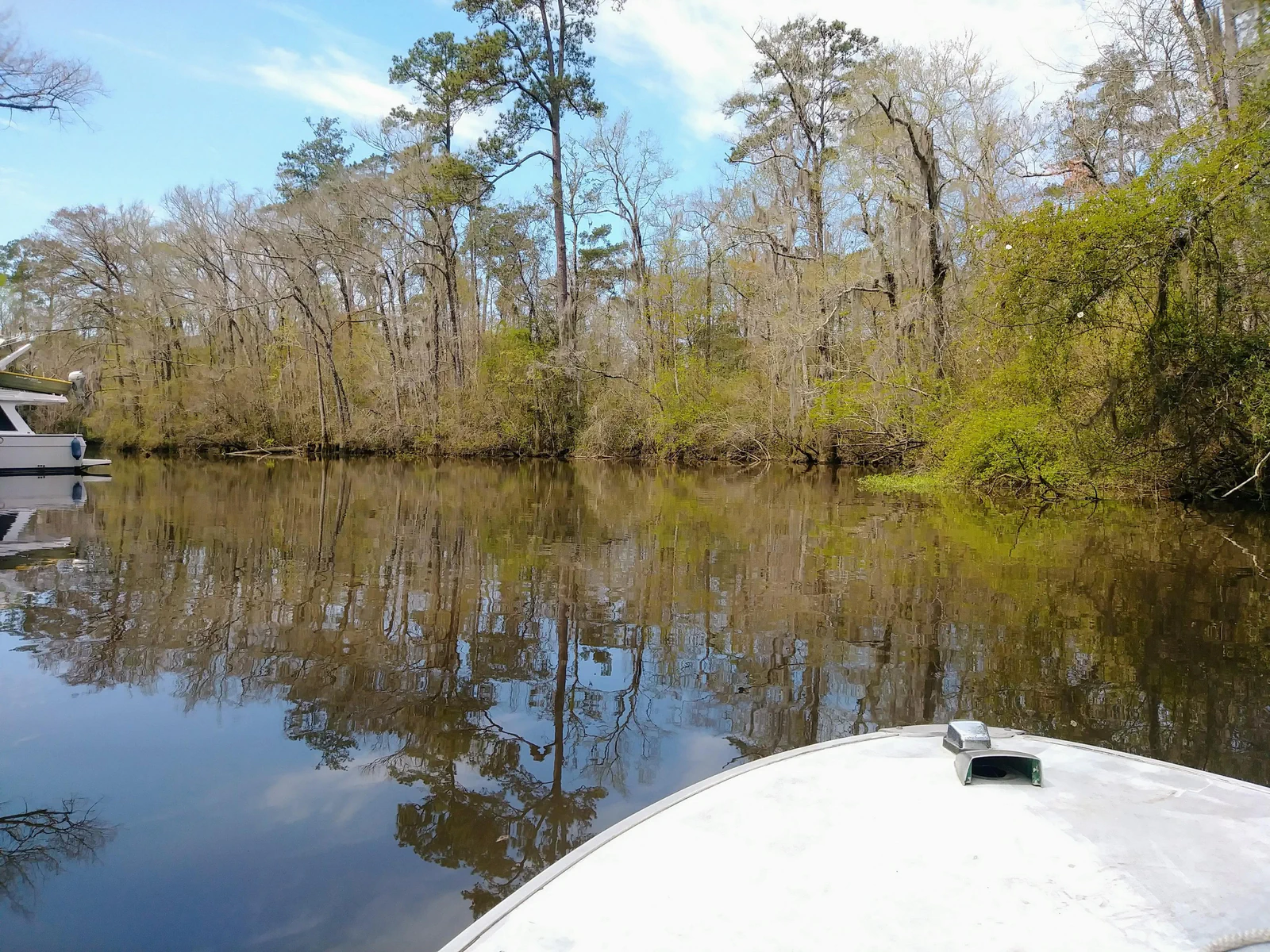
You pull up and the bayou looks rough. Water is moving hard. Color is off. Everything feels pushed. Then you slide into a bend or wood line and the read changes: current is still there, but not ripping; water color improves slightly; bait starts showing; and structure gives fish something to hold on. That is the lane. It will not be perfect, but it will be fishable.
Where to focus
Start where the bayou gives you something readable. If it all looks the same, you are not in the right place yet.
- Cleaner side of bends.
- Wood and shade near a 3 to 7 foot break.
- Side lanes where current softens.
- Bottom seams that still carry food.
How the bite sets up
Different fish use different parts of the same lane. You are not finding fish everywhere. You are finding the part of the lane each species can use.
- Bass: first stable cover.
- Perch: calmer suspended depth.
- Bluegill: softer edges and shade.
- Catfish: bottom seams with organized current.
How to fish it
Keep your bait in the lane. Spinnerbaits and plastics can find bass around cover. Jigs, crickets, and worms fit perch and bluegill holding tight. Cut bait or worms make sense only when the bottom seam is still readable. If the bait will not stay in position, the lane is not right.
When it falls apart
This pattern breaks when the system loses all definition. At that point, you are forcing water instead of reading it.
- No cleaner edge.
- No softened current.
- No stable depth.
- No holding cover.
Bottom line
A rising Bayou Lacombe or Bayou Cane trip is not about finding perfect water. It is about finding the first fishable lane. If the water does not give fish a place to hold, move. When it does, everything tightens up fast.
Why this pattern works
This matters because the fish are not using every good-looking place the same way. The better water is the part of the system where season, movement, water quality, and a fast fallback all overlap. If that overlap is missing, the pattern is probably weaker than the map makes it look.
- Season gives you the broad idea.
- The visible water tells you which version of that idea is usable.
- The first stop should prove the pattern quickly or push you to the next clean fallback.
Use this pattern when
This pattern is strongest when the clearest lane with cover, depth, and manageable current gives you fast, visible proof. Treat the first stop as the read, then verify the lane with what you can see in the first few minutes.
- Strong: bait is crossing structure, not just sitting somewhere nearby.
- Strong: water clarity is holding between stops instead of changing fast.
- Strong: wind is not pushing visible mud lines into the lane you need to fish.
- Weak: no bait movement, no current, or water that gets worse while you are setting up.
How the morning should unfold
Start with the smallest piece of water that can prove the pattern quickly. If the first stop gives scattered feedback, tighten toward the exact structure, cut, edge, or depth change. If it gives no feedback, move toward the nearest cleaner fallback instead of turning the stop into a long soak.
- First stop: Start on the first bend, wood line, shaded bank, or bottom seam where current softens but still carries food.
- If scattered: Move to the next softened lane with better color, more stable depth, or cover that actually lets fish hold.
- If it holds: duplicate the same water shape nearby before making a long run.
When to leave
Leave when the water has answered. Do not wait for dead water to become honest. If nothing repeats quickly, move.
- No bait crossing the lane and no current shaping the stop.
- Water color is getting worse while you are fishing it.
- Bites do not repeat in the same lane or around the same structure.
- The area looks good but never tightens up into a clear read.
How to apply it
Start with the first softened lane, not the prettiest water. Look for the cleaner side of bends, wood and shade near a 3 to 7 foot break, side lanes where current softens, or bottom seams that still carry food.
Quick answers
Can Bayou Lacombe still fish on a rise?
Yes, if you find the first softened lane where current, color, cover, and depth give fish a place to hold.
What is the cleanest first move on Bayou Cane when it is stained up?
Start around a bend, wood line, shaded bank, or bottom seam where the push softens but still carries food.
When should I leave a rising Northshore drain?
Leave when there is no cleaner edge, no softened current, no stable depth, and no cover that lets fish hold.